Australia's October 2026 Financial Stability Review: what it means for your business
The Reserve Bank says Australia's banks are strong and most businesses are coping. It also says costs, rates and cyber risk are rising, and smaller businesses feel it first. Six points from the review, and what each means for a business.
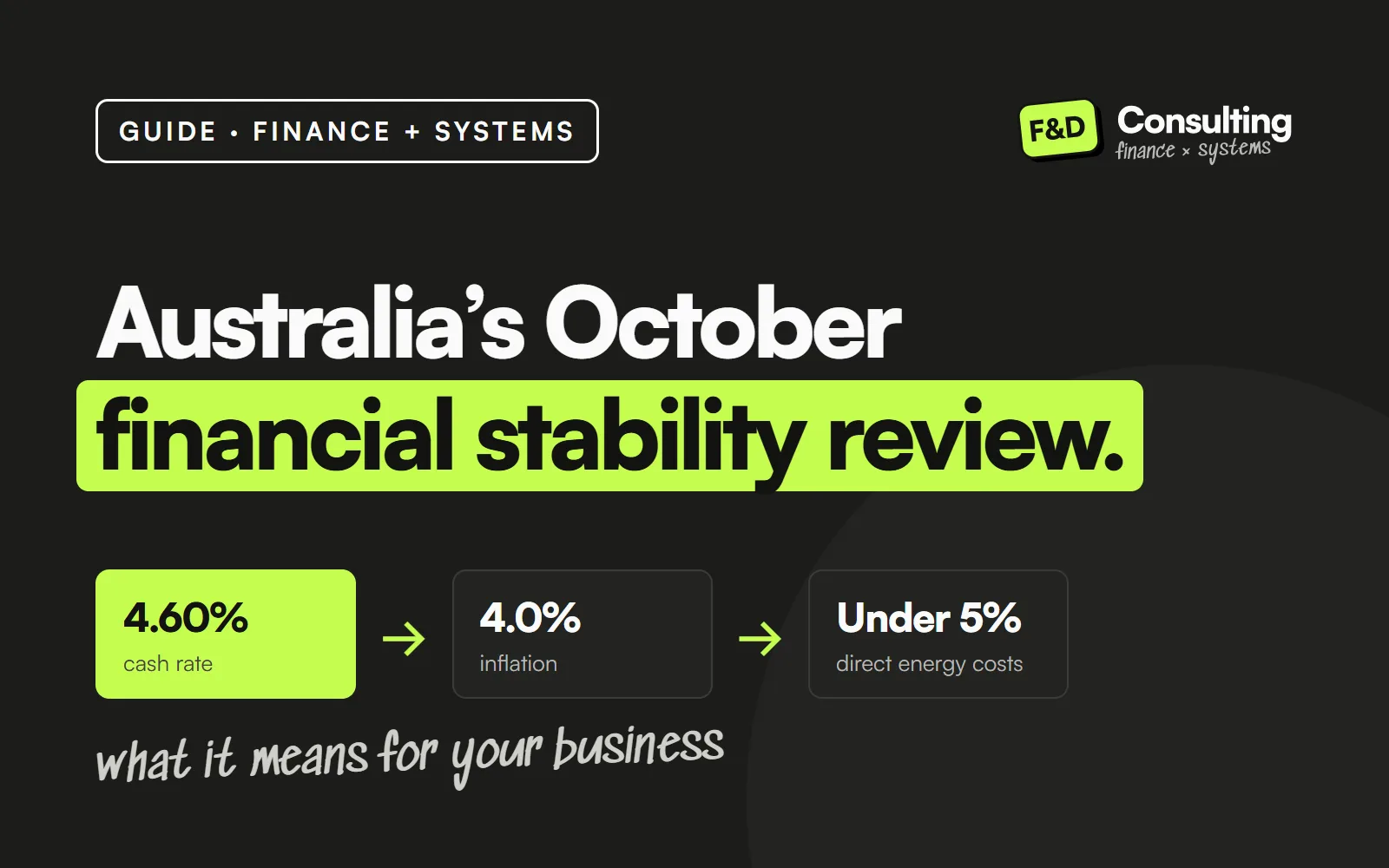
- 4.60% cash rate after four rises in 2026
- 4.0% inflation in the year to August 2026
- Under 5% energy's direct share of most firms' costs
Twice a year the Reserve Bank of Australia publishes its Financial Stability Review: a check on how households, businesses, banks and markets would cope if conditions turned. The October 2026 edition, published on 1 October, opens on a reassuring note. Australian banks are well capitalised, most lenders are still willing to lend, and most businesses entered the year with strong balance sheets and above-average cash buffers.
It also says there is “no room for complacency”. The conflict in the Middle East has pushed up energy and input costs, inflation is above target, and interest rates have risen four times this year. The RBA expects financial pressure to increase in the period ahead, especially for smaller businesses and those in energy-intensive or cyclical industries.
Here are the six findings that land most directly on a business’s cash, costs, customers and systems, and what to do about each.
The banks are strong. The pressure is on costs, cash flow and systems, and smaller businesses feel it first.
The short version
- Rates are up. The cash rate is 4.60% after four rises this year, from 3.60%. Smaller businesses feel it first.
- Inflation is above target. 4.0% in the year to August, against the RBA’s 2 to 3% target.
- The energy shock runs through supply chains. Energy is under 5% of most firms’ direct costs, but the indirect hit is much larger.
- Insolvencies are high in three sectors. Hospitality, construction and transport, and smaller firms are being paid later.
- The ATO is collecting again. Temporary relief for businesses hit by fuel prices has ended.
- Cyber risk is rising. AI is making scams, fraud and attacks faster and harder to spot, and an outage at a shared provider could stop payments.
1. Interest rates have risen four times this year
The RBA raised the cash rate by 25 basis points in February, March, May and September 2026, taking it from 3.60% to 4.60%, to bring inflation back to target. The review notes that rate rises reach smaller businesses faster than larger ones. Many small businesses borrow at variable rates, often secured against the owner’s home, while larger companies tend to have fixed-rate or hedged debt.
What to do:
- Put the new rate into your cash flow forecast. Our 13-week cash flow forecast guide has a free Excel template.
- List every variable-rate facility, including any business borrowing secured on your home, and work out what the rises cost you a month.
- If you will need to refinance or borrow in the next year, talk to your lender before you need the money.
2. Inflation is above target
The Australian Bureau of Statistics reports that consumer prices rose 4.0% in the 12 months to August 2026, up from 3.5% in the year to July, and above the RBA’s 2 to 3% target. The review puts the pressure down to domestic capacity and higher input costs from the Middle East conflict, and expects higher energy costs to keep flowing through to consumer prices until early 2027.
Some businesses are finding it easier than others to pass costs on. The RBA’s liaison suggests transport and construction firms have had more success, while firms reliant on discretionary spending, such as retail and hospitality, face more price-sensitive customers.
What to do:
- Check your margins product by product. Costs that rose a little at a time are easy to miss.
- Review supplier contracts for price-change clauses, and customer contracts for the ability to pass costs on.
- Review prices on a timetable, rather than all at once after margins have gone.
3. The energy shock runs through your supply chain
For most businesses, energy such as petrol, diesel, gas and electricity is less than 5% of total expenses. The review’s point is that the indirect exposure, through suppliers, freight and materials, is much larger. Transport, mining and agriculture are the most directly exposed; construction, manufacturing and hospitality are heavily exposed through their inputs.
The RBA estimates that the share of firms making an operating loss will rise most in energy-intensive industries such as manufacturing, and in retail, where margins are thin, particularly for smaller firms.
What to do:
- Ask your key suppliers what is coming. Price rises announced early are easier to plan for.
- Work out where fuel and freight sit in your costs, directly and through what you buy.
- Look at alternatives for your most exposed inputs before the next price change, not after.
4. Insolvencies are high in three sectors, and small firms are paid later
Overall, company insolvencies are around their long-run average. But they remain elevated in hospitality, construction and transport, the industries most exposed to wage and input cost pressures. The review also notes that overdue trade credit, an early sign of stress, is higher for smaller businesses than larger ones: small firms are already being paid later. (The administration of one large builder and developer will cause a temporary spike in the September quarter figures.)
What to do:
- If you sell on credit to businesses in hospitality, construction or transport, review their payment terms and credit limits.
- Chase overdue invoices early and consistently, and consider deposits or progress payments on larger jobs.
- Watch your own debtor days month by month. A slow drift is the first warning.
5. The ATO is collecting debts again
The ATO gave some temporary debt restructuring support to businesses hit by higher fuel prices earlier in the year. The review notes it has since resumed debt collection, and that help with unpaid tax debt remains one of the most common questions small businesses bring to community and industry organisations.
What to do:
- Keep lodging on time, even if you can’t pay in full. Lodging late adds penalties on top of the debt.
- If you owe tax, contact the ATO early and set up a payment plan before it acts.
- Build GST, PAYG withholding and super into your cash forecast as cash that isn’t yours.
6. Cyber risk is rising, and outages can stop payments
The review’s focus topic is operational risk. It warns that advances in AI are increasing the speed, scale and sophistication of cyber threats, including scams and fraud. It also warns that an outage at a common service provider, such as a key technology or payments provider, could affect a wide range of businesses at once, and that payments stopping for a time could quickly cause financial stress.
What to do:
- Never change a supplier’s bank details on the strength of an email. Call back on a number you already hold. Our guide to supplier bank detail fraud sets out the controls.
- Turn on multi-factor authentication for email, banking and accounting, and remove leavers’ access the day they go. Our Microsoft 365 offboarding checklist covers the steps.
- Plan how you would pay staff and suppliers, and take payments, if your bank, payroll or payment provider were down for a day.
The good news
The review is clear that the financial system is strong. Banks are well capitalised and well positioned to keep lending, even in a significant downturn. Most lenders have not changed their willingness to lend to businesses this year, apart from some reduced appetite for new lending to transport. And most businesses entered 2026 with debt around normal levels and cash buffers above their long-run average. Pressure is rising, but most businesses have room to act on it.
A checklist for this month
- Update your cash flow forecast with the new cash rate.
- Check margins and review prices against rising costs.
- Ask your key suppliers about price changes, and map where energy sits in your costs.
- Review credit terms for customers in hospitality, construction and transport, and chase overdue invoices.
- If you owe tax, talk to the ATO and set up a payment plan.
- Confirm every bank detail change is checked by phone, turn on multi-factor authentication, and plan for a payments outage.
What the review does and doesn’t tell you
The Financial Stability Review is about the financial system as a whole. It doesn’t tell you how your own lender will treat your business, or what rates you will be offered. This guide summarises the published review and the latest official figures for general information. It isn’t financial, tax or investment advice, and the original review should be read for full data and methodology.
If you’d like a second pair of eyes on your cash forecast, your controls or your systems, contact us.
Sources
Share this