IFRS 18: the new income statement, and what auditors will test
The biggest change to the income statement in decades. What IFRS 18 changes, the systems work behind it, and the areas auditors will look at hardest in the first year.
For more than two decades, IAS 1 Presentation of Financial Statements set out what a complete set of financial statements looks like. It left the structure of the income statement largely to the preparer. Companies chose their own subtotals, such as EBIT, operating profit or “profit before exceptional items”, and comparing one company with another suffered for it.
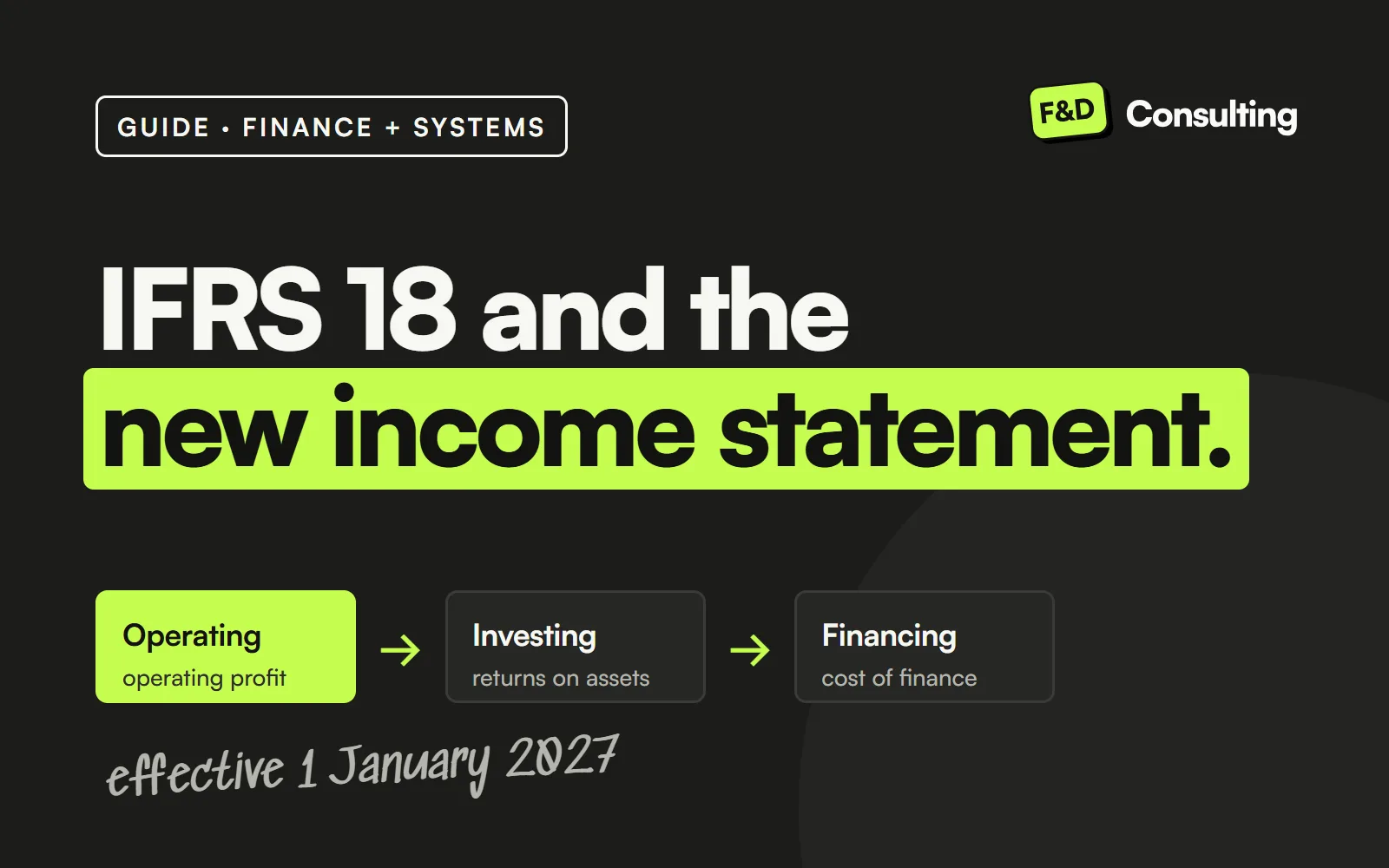
The IASB issued IFRS 18 Presentation and Disclosure in Financial Statements in April 2024 to fix this. It replaces IAS 1 for annual reporting periods beginning on or after 1 January 2027, and early application is permitted. In Australia it arrives as AASB 18, issued in June 2024 with the same effective date.
For a calendar-year reporter, the 2027 financial statements are the first under IFRS 18, with the 2026 comparatives restated on the new basis. The comparative year is already under way, so the preparation window is shorter than the effective date suggests.
IFRS 18 does not change what a company earns. It changes how that performance is shown, and brings management’s own favourite numbers inside the audited financial statements.
Who this matters to
IFRS 18 applies to entities reporting under full IFRS, and their local equivalents such as AASB 18. Check how it applies at your own reporting tier, and confirm the adoption status in your jurisdiction, because local timelines can differ. The IFRS for SMEs Accounting Standard is not directly affected.
Even a business that is not caught directly should read on if any of these apply:
- Loan covenants defined on EBIT, operating profit or EBITDA, where the lender’s own reporting moves to the new subtotals.
- Bonus plans or earn-outs anchored to operating profit.
- A sale, refinance or listing on the horizon, where buyers and lenders will expect IFRS 18 numbers.
- A parent or investor that reports under full IFRS and needs your figures classified its way.
What stays and what changes
IFRS 18 is not a clean-sheet rewrite. Much of IAS 1 carries straight over: fair presentation, going concern, materiality, the statement of financial position, current and non-current classification, and the statement of changes in equity. The balance sheet is largely unaffected.
The real changes fall in three areas:
- A more structured statement of profit or loss.
- New disclosures on management-defined performance measures (MPMs).
- Stronger principles for aggregating and disaggregating information.
The parts of IAS 1 that did not fit IFRS 18 moved to IAS 8, which has been renamed Basis of Preparation of Financial Statements.
The new shape of the income statement
Every item of income and expense must now be classified into one of five categories:
| Category | What goes in it |
|---|---|
| Operating | The default. Everything not classified elsewhere |
| Investing | Returns from assets that generate cash largely independently of the rest of the business: interest on cash, investment property income, results of non-integral associates and joint ventures |
| Financing | Income and expenses from transactions that only raise finance, such as interest on borrowings |
| Income taxes | Tax expense |
| Discontinued operations | As before |
Two new subtotals are mandatory: operating profit or loss, and profit or loss before financing and income taxes. For the first time, every IFRS reporter shows an operating profit figure built the same way.
The classification rules have some details worth knowing early:
- Interest on other liabilities goes to financing, even where the liability did not come from raising finance. The unwinding of discount on a provision, interest on lease liabilities and net interest on a pension liability all sit below operating profit. This one catches people out, because it moves costs many businesses treat as operating.
- Foreign exchange differences follow the category of the item that gave rise to them.
- Derivatives used to manage an identified risk follow the category of the items whose risk they manage. Others generally fall into operating.
- Associates and joint ventures that are integral to the main business sit in operating; non-integral ones sit in investing.
- Entities whose main business is investing or lending, such as banks, insurers and asset managers, apply modified rules, so items that would normally be investing or financing can belong in operating.
Expenses by nature or by function
Companies can still present operating expenses by nature, by function, or on a mixed basis. The new constraint: if you present by function (cost of sales, selling, administration), the notes must also break down five items by nature: depreciation, amortisation, employee benefits, impairment losses and inventory write-downs. Readers of functional statements finally get the cost information they usually have to guess at.
Management-defined performance measures
This is the most visible change for anyone who talks to investors or lenders. An MPM is a subtotal of income and expenses that the company uses in public communication outside the financial statements to show management’s view of performance, and that is not one of the IFRS-required subtotals. Adjusted EBITDA and “underlying profit” are the usual examples.
All MPMs must be disclosed in a single note, with:
- a statement that the measure reflects management’s view of performance;
- how it is calculated and why it is useful;
- a reconciliation to the most directly comparable IFRS subtotal;
- the tax and non-controlling-interest effect of each reconciling item.
The practical consequence is that adjusted numbers from earnings releases and investor decks now sit inside the audited financial statements. Every measure used in public has to be one the company is willing to define and defend. IAS 34 has been amended too, so MPM disclosures also appear in interim financial statements.
No more large “other”
IFRS 18 is clearer about the different roles of the primary statements and the notes, and about how items are grouped. Items should be grouped by shared characteristics, and aggregation must not hide useful information. In practice, a material “other” caption has to be described and broken down further.
Knock-on changes to other standards
| Standard | What changes |
|---|---|
| IAS 7 Statement of Cash Flows | The indirect method starts from operating profit or loss, not profit or loss. The old choices for interest and dividends go: for most entities, interest and dividends paid are financing, and those received are investing |
| IAS 33 Earnings per Share | Additional per-share amounts may only use presented totals or subtotals, or disclosed MPMs |
| IAS 34 Interim Financial Reporting | MPM disclosures are required in interim statements |
| IFRS 1 and others | Consistency amendments |
Transition: the comparatives are restated
IFRS 18 applies retrospectively. The prior-period comparatives must be restated on the new basis, and the financial statements must reconcile the amounts previously reported to the restated amounts. Because the 2026 figures will be shown under IFRS 18 in the 2027 accounts, the mapping and judgements need to be settled while 2026 is still being recorded, not after it closes.
The work behind it
The standard reads like a presentation change. The effort is mostly in finance systems and governance.
- Chart of accounts and systems. Every income and expense account needs mapping to a category. Ledger structures, consolidation tools and reporting templates may need reconfiguring, and this is usually the longest-lead item. Where the chart of accounts has grown by accretion, with catch-all accounts and inconsistent naming, cleaning it up is the first job.
- Classification judgements. Whether the entity has a specified main business activity, and whether each associate is integral, are judgements that need documenting. Auditors will expect a paper trail.
- KPIs, covenants and remuneration. Anything anchored to EBIT or operating profit can move when classification changes. Review loan agreements, bonus plans and guidance early, while there is still time to renegotiate definitions.
- Investor and lender communication. Readers will need a bridge from the old presentation to the new. Early conversations and pro forma comparatives avoid surprises on results day.
- Sector effects. Banks, insurers and investment groups see the largest classification changes. Industrial and consumer businesses feel it mostly through the new subtotals, the nature-of-expense note and MPM governance.
What auditors will test
IFRS 18 does not change how transactions are recognised or measured, so the audit of balances is largely untouched. What changes is presentation and disclosure: every income and expense line now carries a classification, and management’s own metrics move into the audited notes. Expect your auditors’ risk assessment to shift accordingly.
Planning. Under ISA 315, auditors consider how mature the transition project is, how well it is documented and how involved finance leadership has been. Weak project governance is itself a risk indicator.
Before adoption. Financial statements for periods ending before the effective date must disclose the known or reasonably estimable impact of a standard issued but not yet effective, under IAS 8. December 2026 reporters should expect auditors to look for a specific IFRS 18 disclosure covering the main classification effects and the status of the project, not boilerplate.
First year and comparatives. The restated comparatives are new information on this basis. Under ISA 710, auditors need evidence that they are presented in line with the framework: restated figures agreed to the prior year’s audited numbers, reclassification adjustments tested, and the reconciliation from previously reported amounts checked.
Judgements. Main business activity, integral associates, and the classification of derivatives and foreign exchange all call for professional scepticism. Policy papers reviewed early leave time to resolve disagreements before year-end.
MPMs. The measures sit in the audited notes, but they also keep appearing in press releases and the front half of the annual report, which auditors read as other information under ISA 720. Consistency is checked in both directions. Completeness is the harder question: auditors may read your full set of public communications to confirm every measure that meets the MPM definition has been identified.
Controls and IT. The account-to-category mapping becomes a key control. Expect questions about how it is maintained, who can change it, and whether changes to ledger structures, consolidation tools and templates go through effective IT general controls.
Interim reviews and governance. With MPMs required in interim statements, the issue reaches interim reviews as well as the year-end audit. Under ISA 260, auditors will want to discuss the key judgements, the MPM list and transition readiness with those charged with governance, ideally before the first IFRS 18 period begins.
Where the risks sit, and how to be ready
| Area | The risk | What auditors will do | Have ready |
|---|---|---|---|
| Transition and comparatives | Restated figures are unreliable, or the reconciliation to previously reported amounts is incomplete | Agree restated figures to audited prior-year balances, test reclassifications, review the reconciliation | A restatement workbook that ties every line back to the audited prior year |
| Classification judgements | Items misclassified between operating, investing and financing; main business activity or integral associates unsupported | Challenge policy papers against the standard, test a sample of accounts against the mapping | Signed-off policy papers for each judgement |
| Mapping and systems | Accounts missing from the mapping or mapped wrongly; errors from template or system changes | Test IT general controls and mapping change controls, reconcile the new template to the trial balance | A controlled mapping table with an owner and a change log |
| MPMs | Measures used publicly are missed; reconciliations or tax and NCI effects are wrong | Inspect earnings releases, investor decks and board papers; recalculate reconciliations | An MPM register drawn from every public channel, with reconciliations |
| Expenses by nature | Nature data incomplete when expenses are presented by function | Agree the analysis to payroll, fixed asset registers and impairment workings | Nature analysis reconciled to functional totals |
| Aggregation and disclosure | Material “other” balances left undisaggregated; grouping inconsistent | Update the disclosure checklist, size the “other” balances, check consistency | An IFRS 18 disclosure checklist completed against the draft accounts |
| Cash flows and EPS | Wrong starting point; interest and dividends misclassified; per-share measures on non-permitted subtotals | Re-perform the cash flow statement from operating profit, check EPS measures | A cash flow bridge from operating profit, and the EPS basis documented |
Treat the table as a starting point; tailor it to your business and sector.
A roadmap
- Now. Run a gap analysis and identify the main classification issues and judgements.
- Next. Map the ledger accounts, design the new reporting template, and agree the MPM list with finance leadership.
- Before year-end. Prepare restated comparatives and a dry-run set of financial statements, then brief the audit committee and your auditors.
- First reporting period. Publish with clear explanatory disclosures and bridges for investors and lenders.
In short
IFRS 18 trades a decade of every-company-its-own-subtotal for a common structure and real discipline around adjusted measures. The cost is a systems and governance project that is easiest started well before the first reporting date. The businesses that handle it well will:
- map the chart of accounts early, because that is where the long lead time sits;
- document every judgement before the auditors ask;
- build the MPM register from what is actually said in public, not what the finance team remembers;
- dry-run the first year, with restated comparatives, before it counts.
We prepare businesses for this kind of change and for their auditors. We do not audit, and nothing in this guide is an audit opinion or a substitute for your auditor’s view.
Glossary
IFRS 18. The IFRS standard on presentation and disclosure that replaces IAS 1 from 1 January 2027. AASB 18 is the Australian equivalent.
Operating profit or loss. A new mandatory subtotal: income and expenses in the operating category.
MPM (management-defined performance measure). A subtotal of income and expenses used in public communication to show management’s view of performance, and not an IFRS-specified subtotal. Now disclosed and reconciled in the notes.
Specified main business activity. Investing in assets or providing finance to customers as a main business. Entities with one apply modified classification rules.
Integral associate. An associate or joint venture closely tied to the entity’s main business activities. Its results are classified in operating, not investing.
Comparatives. The prior-period figures shown alongside the current period. Under IFRS 18 they are restated on the new basis.
Sources
Share this