Sri Lanka's 2026 Financial Stability Review: what it means for your business
The Central Bank says the financial system is stable. It also says borrowing is dearer, inflation is back above target and lenders are tightening. Six numbers from the review, and what each one means for a business.
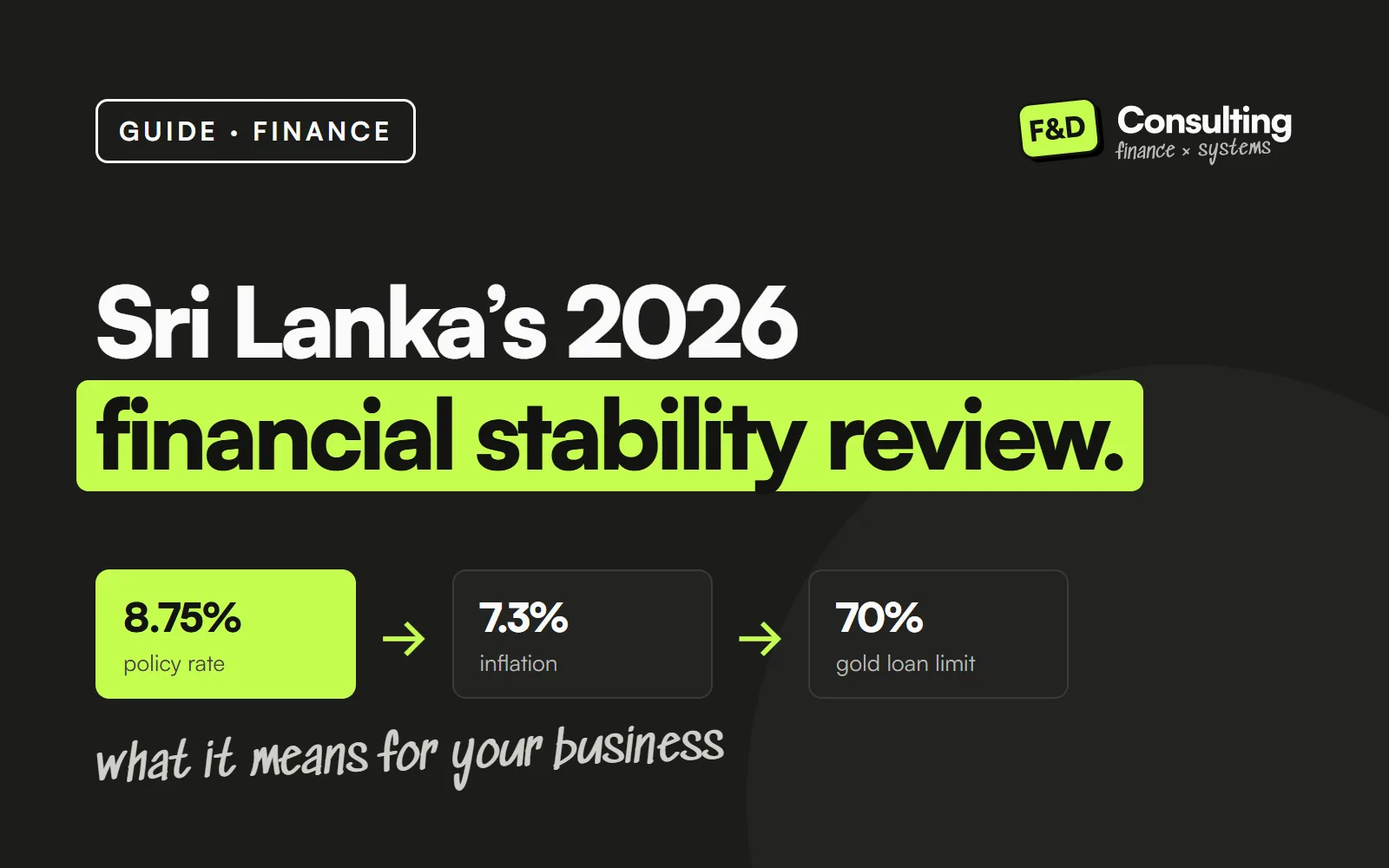
- 8.75% policy rate after the May 2026 rise
- 7.3% inflation in July 2026, against a 5% target
- 23.6% growth in bank lending, double a year earlier
Every year the Central Bank of Sri Lanka publishes its Financial Stability Review: a check-up on the banks, finance companies, insurers, households and listed companies that make up the financial system. The 2026 edition, published in October with data mostly to the end of June 2026, has a reassuring headline. The system is stable, banks are well capitalised and problem loans have come down.
Read past the headline, though, and it describes a system growing faster than the economy underneath it. Bank lending grew 23.6% in the year to June, double the 11.4% of a year earlier. Inflation has returned above target, the Central Bank has raised rates, and it has started to tighten lending where the risk is building.
None of that is a reason for alarm. But several of the findings land directly on a business’s cash, costs, customers and controls. Here are the six that matter most, and what to do about each.
The financial system is stable. The cost of money, and access to it, is changing.
The short version
- Borrowing is dearer. The policy rate is 8.75% after a 100 basis point rise in May.
- Inflation is back. 7.3% in July, above the 5% target, driven mostly by fuel and energy.
- Lenders are tightening. Loans against gold are now capped at 70% of the gold’s value, and vehicle loan limits were tightened.
- Some customers are under strain. More than 1 in 5 loans to tourism and construction small businesses are credit-impaired.
- Payments are cheaper, and fraud risk is higher. No merchant fee on LANKAQR payments up to Rs. 5,000, while cyber-attacks and phishing rank among the industry’s biggest worries.
- Climate is now a financial risk. A 90% chance of a very strong El Niño between September 2026 and January 2027.
1. Borrowing is getting dearer
Inflation rose through the first half of the year, and on 26 May 2026 the Central Bank raised its Overnight Policy Rate by 100 basis points, to 8.75%. Market rates followed. The 91-day Treasury bill yield rose 140 basis points to 9.01%, and the 364-day bill 174 basis points to 9.80%. Lending rates take their lead from these.
What to do:
- Put the new rates into your cash flow forecast. If you don’t have one, our 13-week cash flow forecast guide has a free Excel template.
- List every facility with a floating rate (overdrafts, leases, term loans) and work out what the rise costs you a month.
- Talk to your bank before you need new money, not when you do.
2. Inflation is back above target
Headline inflation rose from 2.1% at the end of 2025 to 7.3% in July 2026, above the Central Bank’s 5% target. The review puts most of it down to fuel and energy prices, after tensions in the Middle East pushed up energy and shipping costs. It also warns that a long spell of higher inflation would weaken the ability of households and firms to repay debt.
What to do:
- Check your margins product by product. Costs that rose quietly over the year are easy to miss.
- Look at your supplier contracts for price-review clauses, and at your customer contracts for the ability to pass costs on.
- Review prices on a timetable, rather than all at once when margins have already gone.
3. Lenders are tightening on some loans
Lending against vehicles and gold has grown fastest. Motor vehicle credit rose from 9.8% of all financial sector credit at the end of 2024 to 12.9% by June 2026, and gold-backed credit from 9.8% to 12.0%. Pawning alone grew 49.2% in a year.
The Central Bank has responded. It tightened the maximum loan-to-value limits on vehicle financing, and from 25 May 2026 a loan secured on gold can be at most 70% of the gold’s value. Banks also hold more capital against gold-backed loans from September 2026. More broadly, lending is growing faster than deposits, and banks’ liquidity and capital ratios, while still comfortably above the minimums, have fallen.
What to do:
- If you plan to borrow against gold or a vehicle, expect to borrow less against it than before.
- Don’t rely on pawning to fund working capital. It is quick, but the limits are now tighter, and gold prices move.
- If you need funding in the next year, start the conversation early and have your management accounts and forecast ready.
4. Some of your customers may be under strain
Overall, banks’ problem loans fell. The gross Stage 3 (credit-impaired) loans ratio dropped from 11.9% to 9.1%. But the review points to strain beneath the surface. Stage 2 loans, which are still being repaid but where the risk has risen significantly, increased in the second quarter. At banks the rise was concentrated in lending to tourism, trade and overseas entities, after the conflict in the Middle East. At finance companies Stage 2 loans rose sharply, which the review links partly to Cyclone Ditwah and the same conflict. And tourism- and construction-related small businesses still have Stage 3 ratios above 20%.
Listed companies tell a similar story: revenue up 22.0% in the first half of 2026, but aggregate net profit down 6.1% as costs rose.
What to do:
- If you sell on credit to businesses in tourism, construction or trade, review their payment terms and limits.
- Chase overdue invoices early, and consider deposits on large orders.
- If you report under SLFRS 9, revisit your expected credit loss assumptions. Our guide to expected credit losses under IFRS 9 explains how.
5. Payments are cheaper, and fraud risk is higher
Digital payments keep getting easier. Since 31 March 2026 there is no merchant fee on LANKAQR payments of Rs. 5,000 or less, peer-to-peer transfers now work over LANKAQR, and the JustPay limit was raised to Rs. 150,000 in February. The review notes that each step widens access, and also widens exposure to fraud and cyber threats.
The industry agrees. In the Central Bank’s Systemic Risk Survey, cyber-attacks and phishing were the most-cited risk after geopolitical tensions, and they have been among the top concerns in every survey since 2025.
What to do:
- Take small payments by QR: it is now free for the merchant up to Rs. 5,000.
- Never change a supplier’s bank details on the strength of an email. Call back on a number you already hold. Our guide to supplier bank detail fraud sets out the controls.
- Make sure a second person approves every payment over a set amount. Our guide to internal controls for small businesses covers how to do that with a small team.
6. Climate is now a financial risk
Cyclone Ditwah, in November 2025, caused an estimated USD 4.1 billion of physical damage, around 4% of GDP, according to the World Bank. The Department of Meteorology now gives a 90% probability of a very strong El Niño developing between September 2026 and January 2027, which could hit rice cultivation, agriculture and small and medium enterprises harder than the 2015–16 and 2023–24 episodes. The review cites estimates that 80% to 90% of catastrophe losses in emerging economies are uninsured.
What to do:
- If you depend on farm produce, energy or imported goods, plan for price and supply shocks over the coming months.
- Check what your insurance actually covers for flood, drought and business interruption.
- Keep a cash buffer, and include a bad-weather scenario in your forecast.
A checklist for this month
- Update your cash flow forecast with the new interest rates.
- Check margins and review prices against rising costs.
- If you will need funding in the next year, talk to your bank now.
- Review credit terms for customers in tourism, construction and trade.
- Confirm that every supplier bank detail change is checked by phone, and that payments need a second approver.
- Check your insurance cover and add a bad-weather scenario to your plan.
What the review does and doesn’t tell you
The Financial Stability Review is about the financial system as a whole: banks, finance companies, insurers and markets. It doesn’t tell you how your own bank will treat your business, or what rates you will be offered. This guide summarises the published review for general information. It isn’t financial or investment advice, and the original report should be read for full data, definitions and methodology.
If you’d like a second pair of eyes on your cash forecast, your controls or your funding plans, contact us.
Sources
Share this